Inquiry
Form loading...
Choosing reliable China top rubber exhaust hose suppliers requires more than comparing prices on a catalog page. Buyers must examine material quality, production experience, testing procedures, and after-sales support. A dependable supplier should explain its rubber compound, reinforcement layers, temperature range, pressure rating, and application limits clearly. These details matter when a hose operates beside a hot engine, exposed to vibration, oil mist, and changing weather.
This guide examines manufacturers that produce Rubber Exhaust Hose for trucks, buses, generators, industrial equipment, and marine applications. It considers factory capability, customization options, quality control, export experience, and technical communication. Practical evidence is important. Product samples, inspection reports, batch records, and clear dimensional drawings can reveal more than polished marketing language. A supplier with consistent processes should also discuss tolerances, connection methods, packaging, and expected service life.
No ranking is perfect. Supplier performance may change with materials, teams, or order volume. That is why buyers should request current samples and verify specifications before placing a large order. In my experience, small details often expose larger risks: uneven hose walls, weak clamps, unclear markings, or delayed answers from a sales representative. Good suppliers welcome technical questions. They also admit limitations instead of promising everything. The following overview provides a practical starting point for identifying capable Chinese manufacturers and building a safer, more dependable sourcing decision.
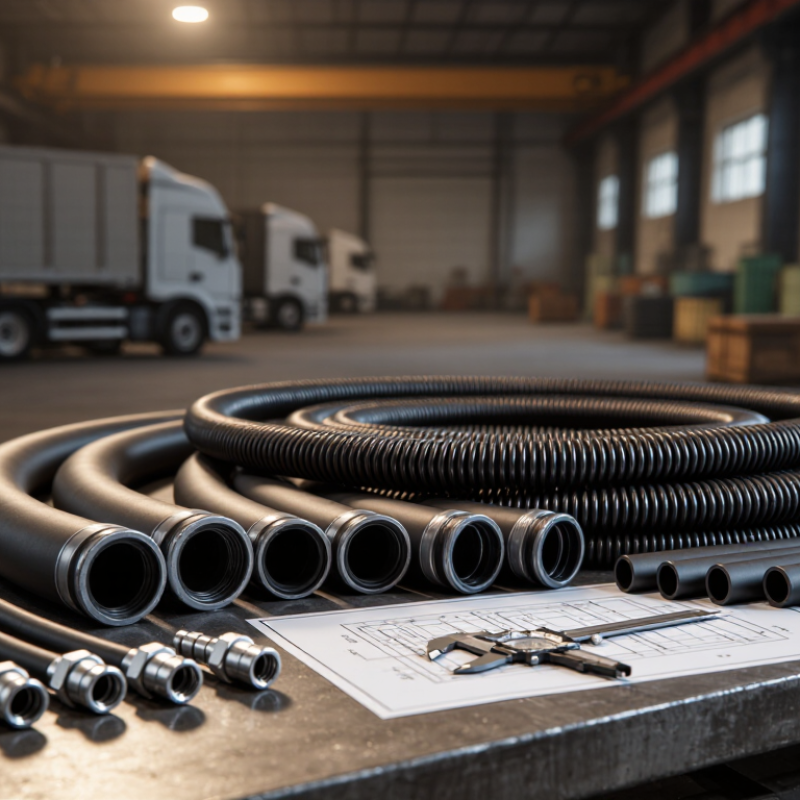
A rubber exhaust hose is a flexible tube designed to carry engine exhaust gases away from a vehicle, machine, or enclosed work area. It usually combines heat-resistant rubber, reinforcement fabric, and a smooth inner wall. This structure helps reduce vibration, resist crushing, and maintain steady airflow.
In practical workshops, these hoses connect exhaust outlets to extraction fans or ventilation systems. They are common in vehicle service bays, generator rooms, marine maintenance areas, and industrial testing spaces. Some models also handle warm air, fumes, or light chemical vapors. However, ordinary rubber should not face extreme exhaust temperatures directly. A high-temperature inner layer is necessary for demanding applications.
During hose selection, I check operating temperature, inner diameter, pressure, bending radius, and mounting space. A loose clamp may leak fumes around a quiet connection. That small fault matters. Reinforced walls are useful where forklifts, tools, or repeated bending could damage the hose. I once saw a hose fail early because its diameter was correct, but its heat rating was ignored. That mistake was simple, yet expensive.
Reliable suppliers usually provide material data, temperature ratings, dimensional tolerances, and test records. Buyers should request samples and inspect the hose after repeated flexing. Surface cracks can appear before a complete rupture. Supplier claims need verification, not blind trust. Resistant rubber, proper clamps, and routine inspection make the system safer and more dependable.
| Data Dimension | Typical Information | Why It Matters | Common Application | Selection Consideration |
|---|---|---|---|---|
| Product Definition | A rubber exhaust hose is a flexible, reinforced hose designed to convey exhaust gases, ventilation air, or hot fumes from an engine, machine, or enclosed area. | It provides a flexible connection between a moving or vibrating exhaust outlet and a fixed ventilation or extraction system. | Vehicle exhaust extraction, generator rooms, workshops, factories, and marine engine spaces. | Confirm whether the hose will carry exhaust gas, hot air, chemical fumes, or a combination of media. |
| Typical Hose Construction | Common construction includes an inner rubber tube, textile or fabric reinforcement, and an outer rubber cover. Some designs include embedded wire or a helical support structure. | Each layer contributes to temperature resistance, flexibility, pressure capability, abrasion resistance, and protection from the surrounding environment. | Heavy-duty exhaust extraction systems and flexible engine connections. | Ask for a cross-sectional specification and verify the reinforcement type before purchase. |
| Common Rubber Materials | EPDM is commonly selected for hot air, water vapor, and weather resistance. Silicone rubber is used where higher continuous temperature capability is required. Nitrile rubber is used when oil resistance is important. | Rubber chemistry directly affects temperature range, resistance to oil and fuel vapors, ozone resistance, and service life. | EPDM for general exhaust ventilation; silicone for high-temperature air; nitrile-based compounds for oil-contaminated environments. | Do not select material from temperature alone; check compatibility with condensate, oil mist, fuel vapor, and cleaning chemicals. |
| Temperature Capability | Many general-purpose rubber exhaust hoses are used around 80–150°C continuously, while specialty silicone or high-temperature constructions may support higher temperatures according to their tested design. | Excessive heat can accelerate hardening, cracking, delamination, or loss of flexibility. | Diesel exhaust extraction, industrial hot-air discharge, and engine ventilation. | Use the manufacturer’s continuous and intermittent temperature ratings, not only the maximum short-term temperature. |
| Diameter Range | Common internal diameters range from approximately 25 mm to 300 mm, with larger sizes available for industrial ventilation and customized systems. | The diameter affects airflow capacity, pressure loss, connection compatibility, and hose weight. | Small engine exhaust outlets, vehicle extraction rails, generator exhaust systems, and industrial ducting. | Measure the actual outside diameter of the connection and allow for clamps, adapters, and thermal movement. |
| Pressure Performance | Exhaust hoses are often designed primarily for low-pressure suction or discharge rather than high-pressure fluid transfer. Working pressure varies by diameter, reinforcement, temperature, and construction. | Incorrect pressure selection may cause hose collapse, ballooning, leakage, or premature failure. | Low-pressure exhaust extraction and flexible ventilation connections. | Specify positive pressure, negative pressure, or both, and request working-pressure and vacuum ratings. |
| Flexibility | Flexible rubber construction absorbs vibration and permits movement. Bend radius depends on the hose diameter, wall thickness, reinforcement, and temperature. | A hose bent below its recommended radius can kink, restrict flow, or damage the reinforcement. | Vehicle exhaust reels, movable machinery, engine mounts, and articulated extraction arms. | Compare the required movement cycle and bend radius with the supplier’s tested specifications. |
| Resistance Properties | Depending on the compound and cover, a rubber exhaust hose may offer resistance to heat, abrasion, ozone, weathering, vibration, oil mist, and dilute chemicals. | The external environment can be as damaging as the exhaust medium, especially in workshops and outdoor installations. | Outdoor generator systems, vehicle service centers, industrial plants, and marine applications. | Request separate inner-tube and outer-cover resistance information because their properties may differ. |
| Vehicle Exhaust Extraction | Used to capture exhaust gases from cars, trucks, buses, agricultural equipment, and other combustion-engine vehicles before they enter the workplace. | Effective extraction helps reduce worker exposure to carbon monoxide, nitrogen oxides, particulate matter, and other combustion by-products. | Automotive repair shops, inspection stations, fleet maintenance facilities, and emergency vehicle garages. | Check the tailpipe adapter, hose temperature rating, reel compatibility, and airflow requirements. |
| Industrial and Generator Use | Used for temporary or permanent exhaust routing on generators, compressors, pumps, forklifts, construction equipment, and industrial engines. | Flexible connections accommodate vibration and thermal expansion while directing gases away from occupied areas. | Power-generation rooms, construction sites, warehouses, factories, and temporary power installations. | Consider vibration frequency, exhaust condensate, mounting supports, back pressure, and outdoor weather exposure. |
| Marine and Engine-Room Use | Specialized exhaust hose can be used in marine engine compartments and other confined machinery spaces when its construction and certification are suitable for the application. | Marine installations require careful control of heat, vibration, water exposure, and exhaust leakage. | Boats, work vessels, engine rooms, and auxiliary power systems. | Verify applicable marine requirements, approved construction, installation orientation, and clearance from combustible materials. |
| Connection Methods | Typical connections use hose clamps, band clamps, flanges, sleeves, reducers, quick-release couplings, or vehicle-specific adapters. | A compatible connection reduces leakage and prevents excessive stress at the hose ends. | Fixed exhaust pipes, movable extraction equipment, ventilation ducts, and engine outlets. | Match the clamp type and material to the temperature, vibration, corrosion environment, and connection geometry. |
| Quality Verification | Important checks include dimensional inspection, visual inspection, hardness, tensile properties, adhesion, pressure or vacuum testing, temperature testing, and batch traceability. | Documented testing improves consistency and helps identify unsuitable materials or construction defects. | High-volume industrial purchasing, safety-critical exhaust routing, and long-term maintenance programs. | Request inspection records, material declarations, production dates, and sample testing where appropriate. |
| Relevant Standards | Applicable standards depend on the product and end use. Commonly referenced frameworks may include ISO 1307 for hose dimensions, ISO 6806 for rubber hoses used with oil burners, and sector-specific automotive, industrial, or marine requirements. | Standards help define dimensions, performance tests, safety requirements, or installation expectations. | Industrial procurement, automotive service equipment, and regulated installations. | Identify the required market, application, and certification before requesting compliance documentation. |
| Service-Life Factors | Service life is influenced by temperature cycles, vibration, bending frequency, ozone, abrasion, chemical exposure, condensate, installation stress, and maintenance quality. | A hose with a suitable nominal rating can still fail early if it is installed incorrectly or exposed to unlisted chemicals. | All exhaust extraction and hot-air conveying systems. | Inspect regularly for cracks, blistering, soft spots, hardening, loose clamps, discoloration, and exhaust leakage. |
| Supplier Evaluation Criteria | Useful evaluation factors include compound control, reinforcement design, dimensional consistency, testing capability, customization, documentation, production capacity, and export packaging. | These factors are generally more useful than price alone when comparing rubber exhaust hose sources. | OEM replacement, distributor supply, project procurement, and customized industrial assemblies. | Compare like-for-like specifications, request representative samples, and verify test data against the intended operating conditions. |